Sunday, June 13, 2021

Cross-cultural wisdom (Hebrew Bible, Buddhism, and Dao De Jing)

Wisdom is not limited to one religion or one culture. It is widespread across cultures and religions. 

-hebel (Hebrew) means (mere) breath (for example, Eccl. 1:2). cf, vapor, vanity.
-apar (Hebrew) means dust (Gen 2:7; Eccl 12:7).
-ruach (Hebrew) means wind or spirit (Gen 1:2; Eccl 12:7).
-nishmat hayyim (Hebrew) means breath of life (Gen 2:7).
-annica (Sanskrit) means impermanence; part of three noble teachings of Buddhism.
-anutpanna aniruddha (Sanskrit) means "no arising, no ceasing"; part of the Heart Sutra.
 

Regarding the full text of the Dao De Jing, see my English translation.

Thursday, June 10, 2021

My Teaching Identity for Transformation and Solidarity

My Teaching Identity for Transformation and Solidarity

I ask myself what it means to be a balanced teacher, down-to-earth scholar, and authentic human being in the community and society. I am as dedicated as ever to fulfilling my motto of transformative teaching, indomitable scholarship, and effective public service.

I have a passion for human transformation, rooted in self-knowledge and self-criticism. Traveling to many Latin American countries during my business career, I learned a great deal about cultural diversity and the need for human solidarity. What does it mean to live in this world with each other (i.e., the meaning of the Other, which resonates with Emmanuel Levinas' "the face of the other," Paul Ricoeur's "inter-subjective narrative identity," and Jacques Derrida's "relationless relation")? How can we do theology in our thoughts and deeds, while moving pointedly away from individualism? And how can we read biblical stories with each other when we differ?

I foster and teach to engage in the knowledge of who we are in this world in which we see our diversity and differences. In my teaching, diversity is not a given but a source of critical engagement with each other. I value both a critical and self-critical stance toward any claim of knowledge, truth, and reality. I emphasize the following as pedagogical goals: learning from others, challenging one another, affirming who we are, and working for common humanity in differences. In my teaching, all in all, I communicate critical diversity and transformative identity in a variety of life contexts.

We all live in a harsh world. To a different degree, we experience marginality. I believe marginality is a creative space for transformation. There are three moments or attitudes which are conducive to human transformation:

"I am no-one" is an attitude that I am nothing before God. I am the dust (ʿāpār, Gen 2:7; hebel, Eccl 1:2)! We are the dust and need the grace of God. When you confess that "I am no-one," God would say you are not no-one.

"I am some-one" is a mode that I reclaim that I am. I am more than the dust. I am given the breath of life (nišmat ḥyym, Gen 2:7). I am the spirit. Nothing or no one can bring me down. I am that I am.

"I am one-for-others" is a commitment that I have a moral duty to support others. I am a living being (nepeš, Gen 2:7) and find joy in living with them.
A good teacher satisfies students, a wonderful teacher teaches what they need, and an ideal teacher teaches them with love, helping them to teach themselves.

A good student follows the teacher's instruction, a remarkable student asks critical and self-critical questions, and a formidable student knows that learning is limitless.

A good author satisfies readers, an admirable author stimulates their interest, and an exceptional author creates new needs for them.


Saturday, June 5, 2021

Three Marks of Existence in Early Buddhism

Three Marks of Existence in Early Buddhism:
1. Annica (impermanence): "everything changes" in the world or universe (cf, hebel in Eccl 1:2).
2. Anatta means there is no fixed self in the existence of all things.
3. Dukkha means all things are involved in suffering.


More about this teaching

Friday, June 4, 2021

Dao De Jing

Dao De Jing is a classical wisdom book, purportedly written by Laozi. It is one of the most-read books in the world today. It comprises 81 short poems. Here is my translation: PDF.

Thursday, June 3, 2021

John 14:6

Excerpts from Yung Suk Kim, Truth, Testimony, and Transformation: A New Reading of the "I Am" Sayings of Jesus in the Fourth Gospel (Cascade, 2014)

When Jesus says in the Fourth Gospel, "I am the way, the truth, and the life," does he mean that Christianity is the only true religion, or did he mean something else? As we know, Jesus did not found a new religion nor did he pave a new way to salvation or truth. Rather, Jesus worked for God, by showing the way of God, testifying to the truth, and engaging in the work of liberation. Jesus in the Fourth Gospel, like Moses, is sent by God to liberate people from darkness. Unlike today's triumphant Christianity, the Johannine community was a small, marginalized, expelled community that struggled because of their faith. It will be very interesting to see how this struggling community was transformed into a loving community, following the model of Jesus.

I wrote this book out of my hope that the Fourth Gospel and John 14:6, in particular, could be the scripture of engagement, embodiment, and empowerment for Christian readers. I hope this book will help the reader rethink the role of the Logos or the "I am" sayings in the Fourth Gospel. In a pluralistic society, the focus of the gospel shifts from conversion or theological doctrine to the empowerment of people. I dream that this book will contribute to theological education in that the "I am" sayings of the Fourth Gospel give a voice to inclusivism rather than exclusivism, solidarity rather than marginalization, and liberation rather than oppression. In the pluralistic life contexts of America today, the theology that accepts others as friends is very important; it engages others on the basis of God's love and justice. With a focus on the language of embodiment and empowerment, theological education can be more inclusive to others and help students reorient their attention to the present life in the world.


Monday, May 31, 2021

Summing up my trip to Oregon

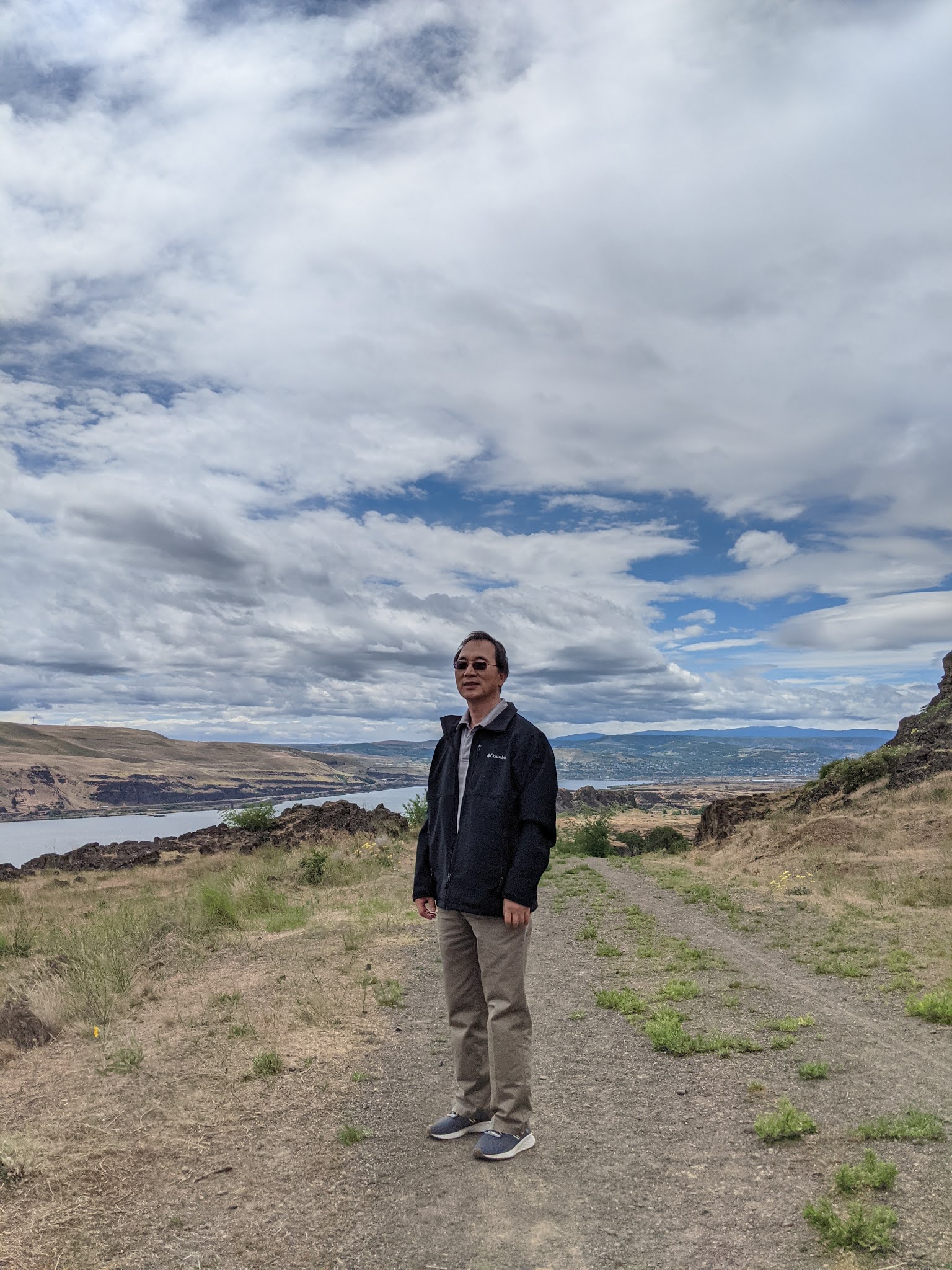
I came back home 10 days after my wife and I have spent quality time with our daughter in Hillsboro, Oregon. Things that I saw and cherishable memories that I hold will stay with me for a long time. In particular, I cannot forget Columbia Hills Historical State Park—a result of the cataclysmic changes during the Ice Age floods that reshaped the surrounding regions of the Columbia River, a trip to Bend, Oregon where Cascade Lakes Scenic Byway thrilled us, and Cannon Beach that holds the time and history of millions of years. I also cannot forget numerous yet valuable pebbles at the beach, which were not made one time. Each pebble is unique and beautiful. It preserves its own time and history.

Wednesday, May 19, 2021

Cherishing those days


Two years ago, I was like this, speaking at the conference of the UMC Western PA Annual Conference held in Grove City College, with thousands of people gathered. I cherish those days when I met various people in person. Virtual meetings cannot replace real ones.

Thursday, May 13, 2021

Jung Do-Jeon (1342-1398)

Jung Do-jeon (1342–1398) was a prominent scholar and politician of the late 14th-century Goryeo dynasty. He helped Yi Seong-gye found a new kingdom, Joseon, bringing an end to Goryeo, whose political-religious foundation was Buddhism. The Joseon dynasty lasted for about five hundred years, until the 19th century.

Jung’s political and scholarly vision was to establish a newly reformed state governed by commonsense principles rooted in the lives of ordinary people. He was highly critical of the Buddhism of his day, especially of hypocritical elites who amassed wealth while securing promises of future salvation. As temples and elites grew richer, the people became poorer.

He rejected “reincarnation,” a core Buddhist doctrine according to which a person continues life after death. In exchange for the hope of a better rebirth, people were urged to donate large sums to temples. This, he argued, bred religious corruption, as elites enriched themselves through this alliance with an elite religion.

Jung Do-jeon challenged the absurdities he saw in the idea of reincarnation in his book Bulssi japbyeon. He observed: “We look at the beautiful flowers and leaves in spring and see them fade and fall to the ground. They return to the place from which they came.” He rejects rebirth with the question: “How can we expect the same fallen flowers or leaves to come back to life the next spring?” An old life ends; a new life begins. What emerges from the ground in spring is new life, not a rebirth. Old leaves and flowers decay and become fertilizer for the new. In short, he argues that reincarnation is an absurd idea. 

He also writes: “How can we inhale the very breath we have exhaled? Each time we exhale, we inhale a new breath, not the same one.” Likewise, a spring issues ever-flowing water that is never the same; the original water evaporates and becomes clouds. Furthermore, in his view, “reincarnation” is a selfish desire to prolong one’s existence after death. Death is the end and should be accepted as natural.

I believe his critique is still compelling today, when many focus excessively on the next life while neglecting their responsibilities in the present world.

The following poem was written by Jung Do-jeon when he first met Yi Seong-gye.

蒼茫歲月一株松 / 아득한 세월에 한 그루 소나무
生長靑山幾萬重 / 푸른 산 몇 만겹 속에 자랐구나.
好在他年相見否 / 잘 있으시오. 훗날 서로 뵐 수 있으리까?
人間俯仰便陳蹤 / 인간 세상이란 잠깐 사이 묵은 자취인 것을.
— 정도전, 《제함영송수 (題咸營松樹)》

a pine tree standing alone for a long time;
It has grown so big now through millions of mountain trails.
Goodbye now to you; can we see each other in the future? The human world is passing like a fast-moving arrow.
[Trans. Yung Suk Kim]


The following poem was written by Jung DoJeon before he died (or was killed).

操存省察兩加功 / 조심하고 조심하여 공력을 다해 살면서
不負聖賢黃卷中 / 책 속에 담긴 성현의 말씀 저버리지 않았네.
三十年來勤苦業 / 삼십 년 긴 세월 고난 속에 쌓아 놓은 사업
松亭一醉竟成空 / 송현방 정자 한 잔 술에 그만 허사가 되었네.
— 정도전, 《자조》

With every effort and caution, I have lived a life very well.
I did not break the wisdom of the sages in their literature;
A 30-year achievement made through trials and errors
came to an end in vain because of a glass of wine at the Songhyunbang.
[A rough translation of mine]


Monday, May 3, 2021

Western Christianity's Biggest Problem: A Narrow Understanding of Faith


Knowing the dominant form of Western Christianity was influenced by Augustine and Luther, we must point out the weakness of these Christian theologians who failed to see the diverse aspects of faith in the New Testament. So much so their understanding of faith and salvation is very limited. It may be summarized as follows: 
1) Individual salvation or justification: imparted or imputed righteousness (forensic salvation); 
2) Introspective, inner faith out of guilt rather than public faith; 
3) Invading, exclusive gospel: colonialism and exclusivism. 

But the prevailing aspects of Christian faith have to do with “participatory faith,” as in the four Gospels and Paul’s 7 undisputed letters. There are also other minor aspects of faith: faith as knowledge, faith as works, and faith as a conviction.

Monday, April 26, 2021

"Race, Ethnicity and the Gospels"

 Finally, my article "Race, Ethnicity and the Gospels" was accepted for publication.